This is a special edition of the newsletter — we’re breaking down Entrata’s recent S-1 filing. Their IPO will be an interesting case study on how public markets value vertical software businesses in the age of AI.
Founded in 2003 in Lehi, Utah, Entrata sells property management software to multifamily owners and operators. It powers 2.5M units (~10% of the U.S. multifamily market) and counts 4 of the NMHC top-10 operators as customers. Like its peers in the PMS space (Yardi, RealPage, Appfolio, etc.), Entrata bundles property accounting, leasing, payments, resident experience, and utility and resident billing into a single system of record.
After two decades in private hands it’s finally stepping into the light. The company is targeting $500M as part of its IPO and will trade on the NYSE under the ticker ENT. It’s likely the largest software company ever to IPO while growing 20%+ and achieving GAAP operating profitability. Let’s dig in!
Financial Profile
Here’s the headline financial picture from the filing:
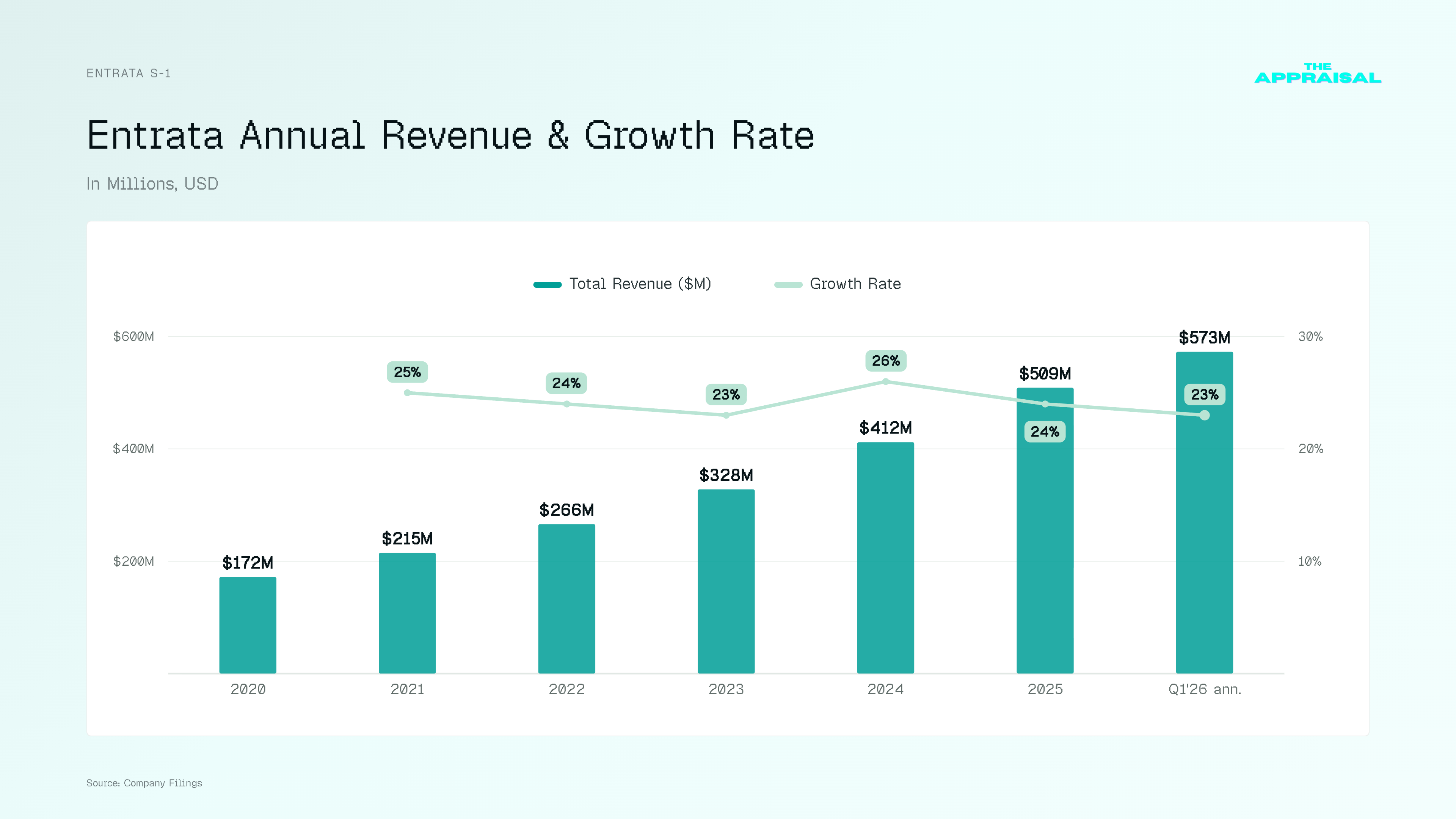
Revenue of $509M in 2025, up ~24% from $412M the year prior. Subscription-related revenue is ~86% of the total; embedded payments are the smaller but faster-accelerating piece, growing ~34% year-over-year in the most recent quarter.
2.49M billed units at an average revenue per unit (ARPU) of ~$216 per unit per year.
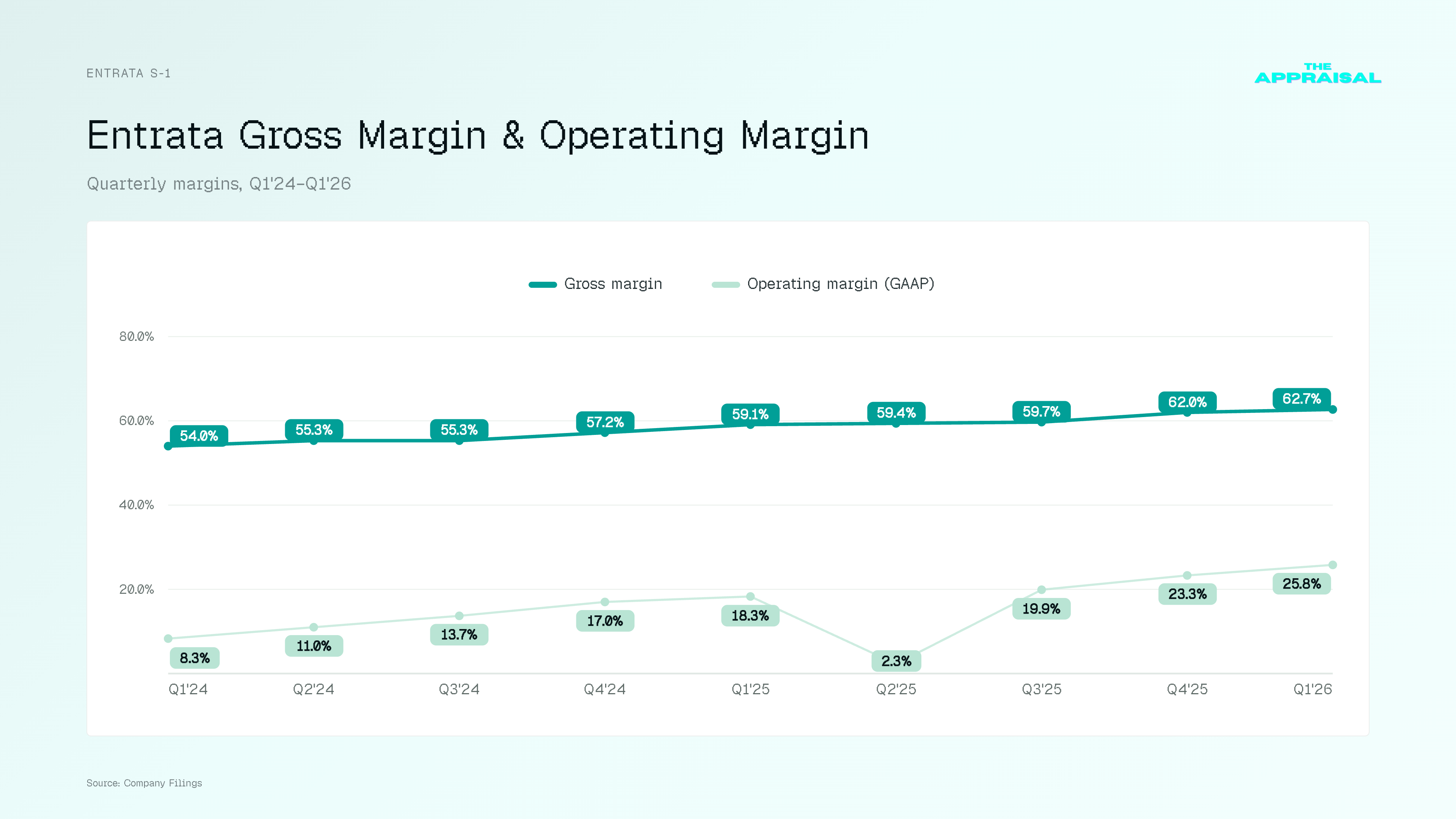
Gross margin of 63% in Q1’26, up from 54% in Q1’24.
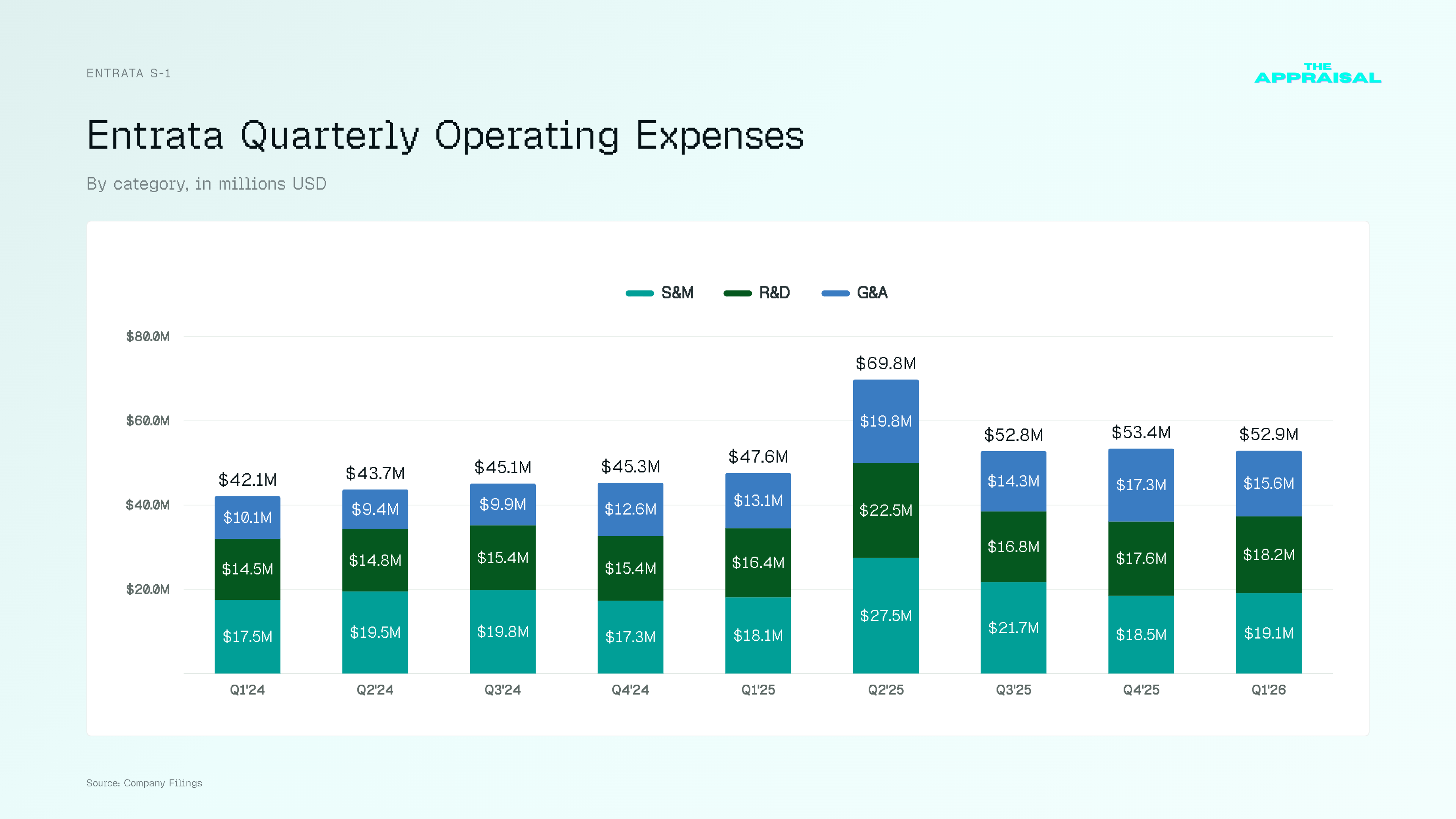
GAAP operating margin of 16% in 2025, and 26% in Q1’26. This is a profitable software company; Entrata generated $51M of net income in 2025, up from $22M.
Net revenue retention of 117% and gross retention of 97–99%. Customers generating more than $500K of ARR grew 27% to 233 accounts, and now represent 84% of total ARR.
This is a profitable, sticky, enterprise software business. Revenue compounds ~4% a quarter, margins are expanding, and net revenue retention is strong (all hallmarks of a classic control point business).
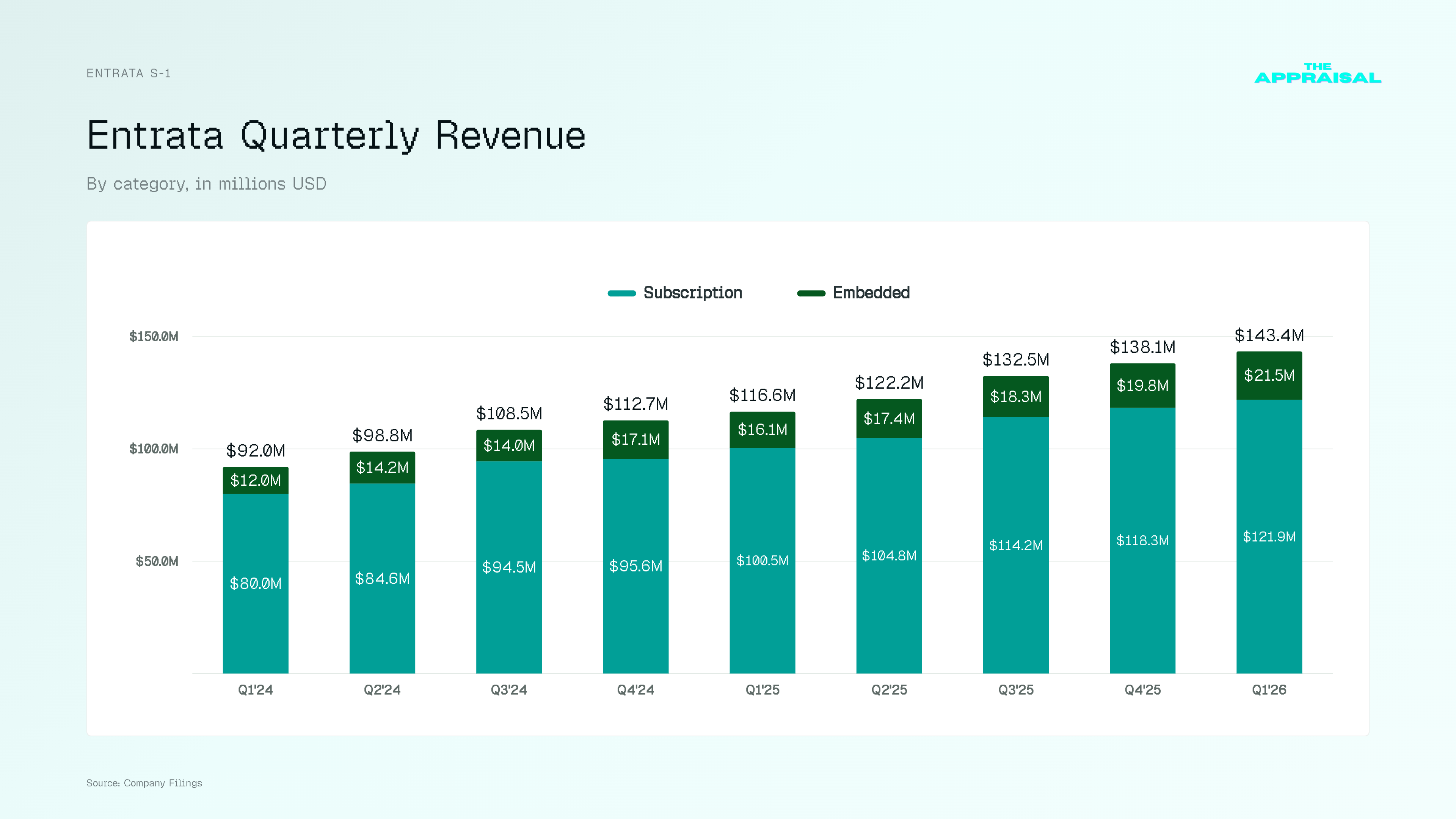
Entrata’s revenue comes in two forms. The bulk — about 86% — is subscription: recurring fees for the software platform and its modules (accounting, leasing, payments, resident experience, billing). The other ~14% is embedded payments — Entrata takes a cut of the rent and fees that flow through the platform, so that line scales with payment volume rather than seat count.
The two are growing at almost the same pace — subscription ~23%, embedded payments ~25%. That’s worth noting: Entrata isn’t leaning on payments to paper over a software slowdown. Both engines are running, with payments just edging ahead.
Revenue growth is driven by two levers: more units, and more revenue per unit. In 2025, billed units grew ~15% — Entrata won and expanded enterprise accounts — while ARPU rose ~8%, from $194 to $209. That’s roughly two-thirds volume, one-third price: a healthy composition, with real unit growth underneath rather than pure price hikes.
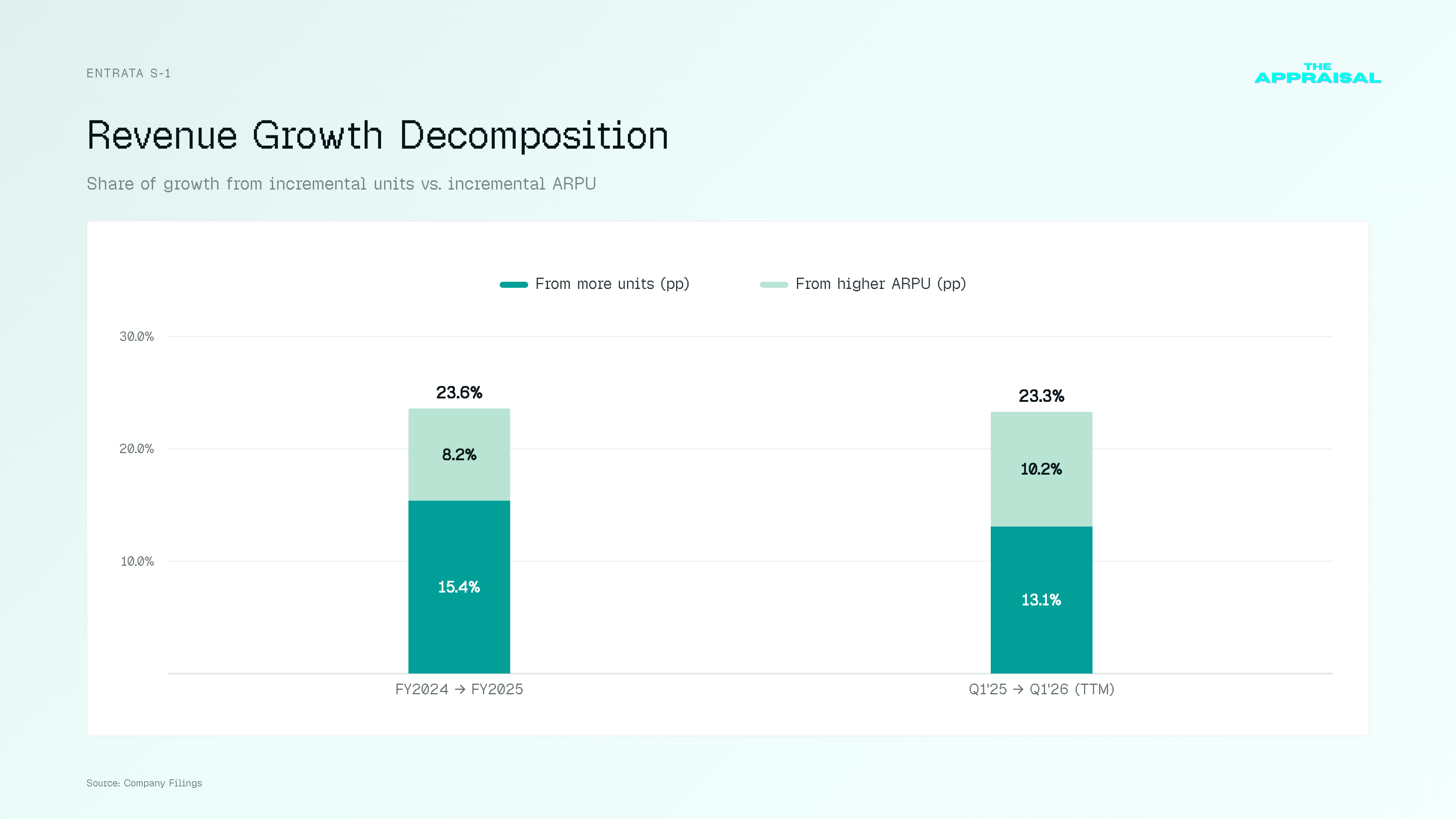
Over the most recent year, units grew ~12% while ARPU jumped ~10%, to $216 — and the split moved closer to 55/45. ARPU is becoming a bigger share of the story as the installed base matures and Entrata sells more modules and payments into it. That’s the “monetize the base harder” dynamic the bull case rests on, already showing up in the numbers — and worth watching to see if it keeps building. Entrata's ARPU is already ~2x AppFolio's, and likely best-in-class amongst its PMS peers. The question is whether it can keep growing revenue per unit by selling more products around the PMS core.
Net revenue retention sits at 117% in both 2024 and 2025, meaning every cohort spends ~17% more a year later. Gross retention is 97–99%. And customer concentration is improving in the right direction: customers over $500K of ARR grew from 183 to 233, and now make up 84% of revenue.
Entrata does ~$500M of revenue inside a serviceable market it pegs at ~$5B today, so its current ~10% market share implies there is room to capture incremental share over time. However, it’s an extremely crowded category: the PMS space is mature and fully contested, and the underlying unit base barely moves, growing just ~2–3% a year.
But two green shoots stand out:
The first is consolidation — the 50 largest operators have grown their managed units ~48% since 2020 (an ~8% CAGR), concentrating share into exactly the enterprise segment Entrata serves best, so its real addressable market is compounding far faster than the housing stock.
The second is demographics — renters are forming households roughly 2x faster than homeowners through 2040, and housing affordability challenges are keeping people renting longer. The result is a structurally growing, fuller base of rental units.
Entrata vs. AppFolio
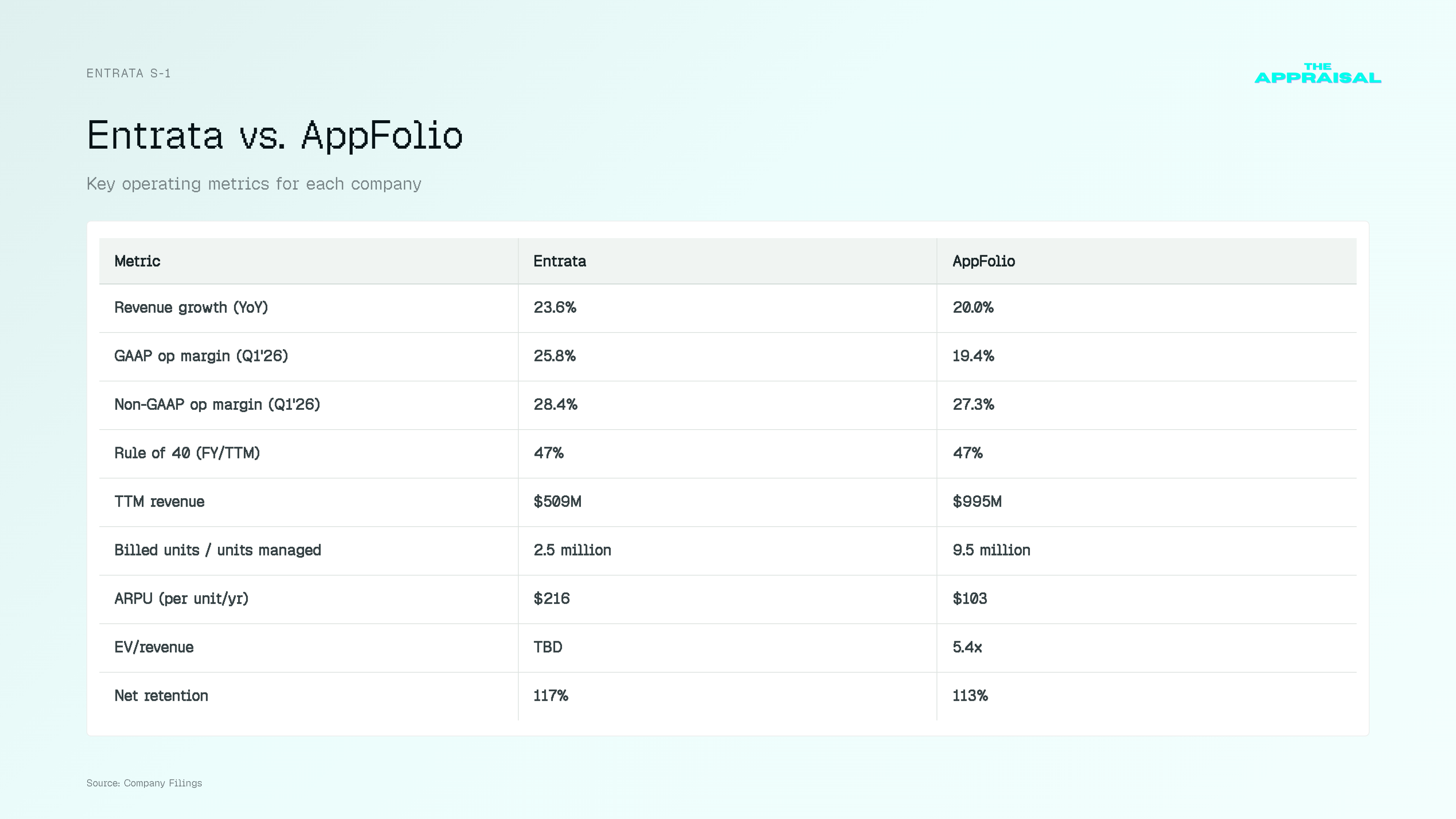
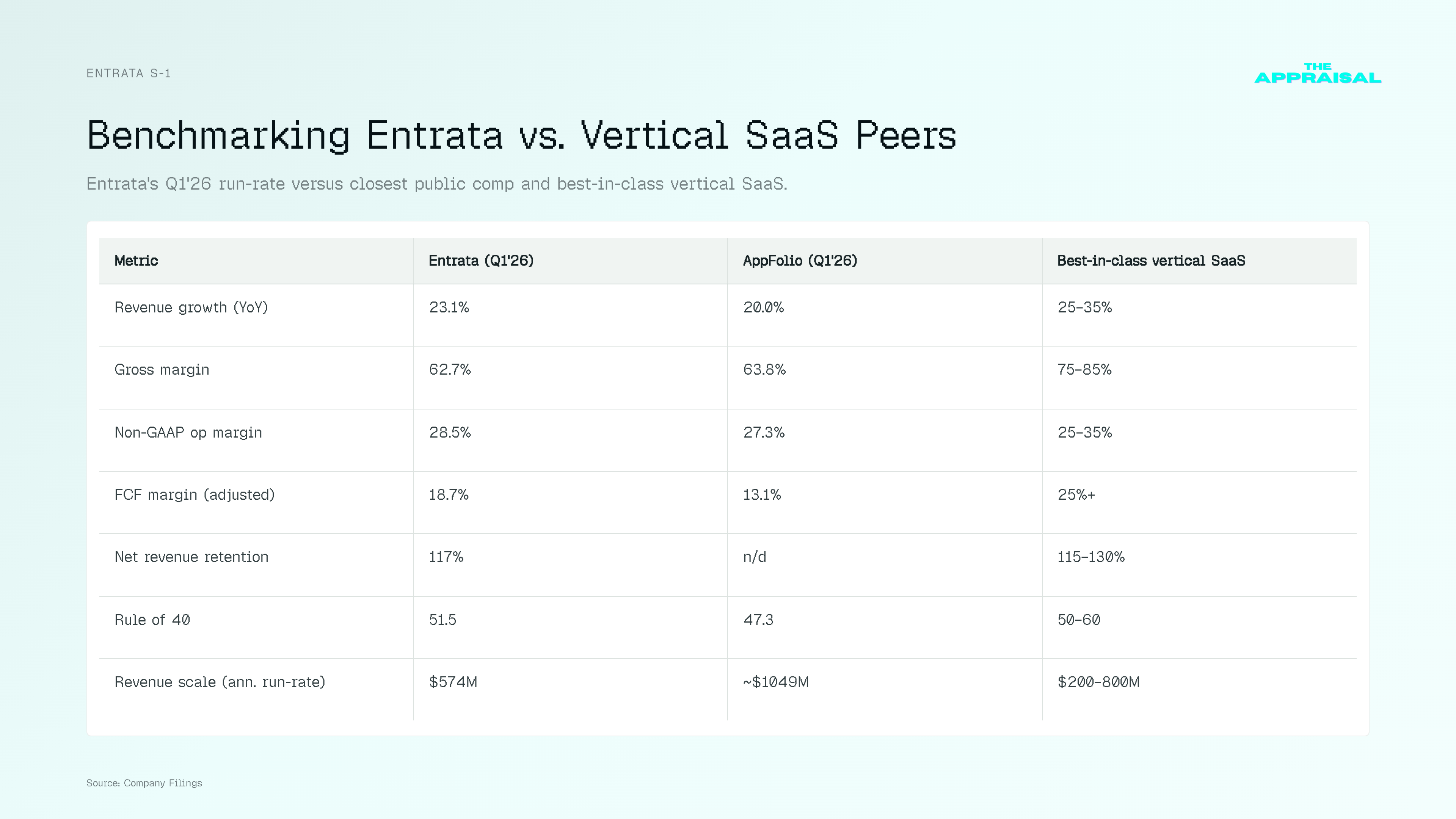
We’ll soon have two publicly traded PMS vendors in the real estate index. AppFolio climbed up from SMB — it won the smaller operators first, then moved upmarket. Entrata is coming down from enterprise — it won the largest operators first, and is now pushing toward the middle. They’re converging on the same stretch of the market from opposite ends. Here’s how the two companies compare:
Growth. Entrata is growing faster (24% vs. 20%) and has been for a few quarters running.
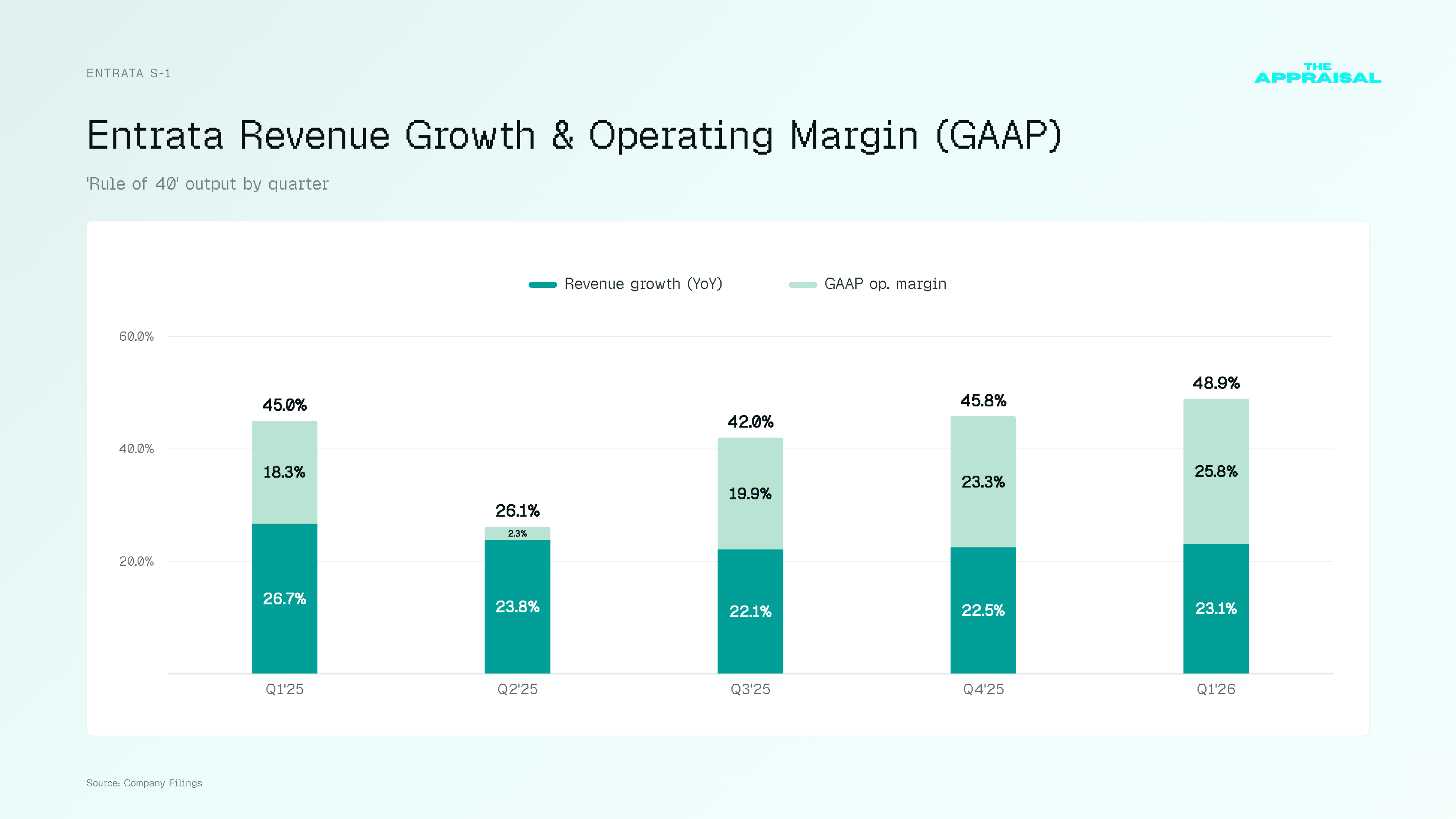
Rule of 40. Dead even at ~47. Both healthy; neither in the elite 50–60 band on a full-year basis.
Scale. AppFolio is roughly 2x the revenue (~$995M vs. $509M TTM) and sits on ~9.5M units under management against Entrata’s 2.49M billed units.
ARPU. Entrata does a better job monetizing its customer base — $216 per unit per year (roughly 1% of gross rents) vs. AppFolio’s $103 per unit per year. Part of this is explained by Entrata’s focus on enterprise segments vs. AppFolio’s more SMB focus.
Margins. Comparable in the latest quarter — Entrata’s ~28% non-GAAP operating margin edges AppFolio’s ~27%. But AppFolio’s full-year margin is higher and cleaner.
Valuation Expectations
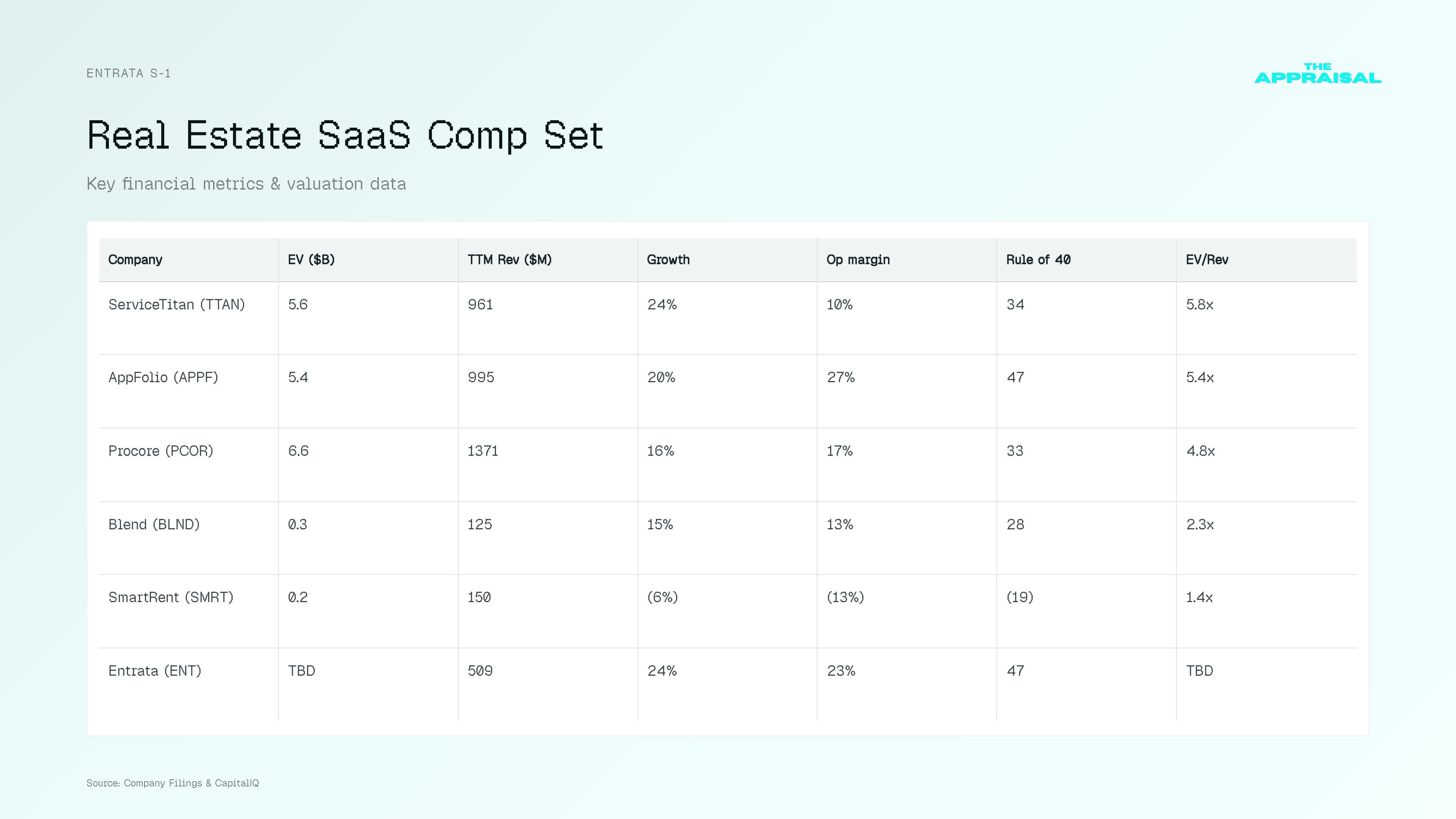
In a pre-AI world, this is a slam-dunk IPO — the kind of clean, durable software name that likely trades at 10x+ forward revenue without anyone thinking twice. The same profile now draws a sharper question: is a two-decade-old system of record a fortress, or a target?
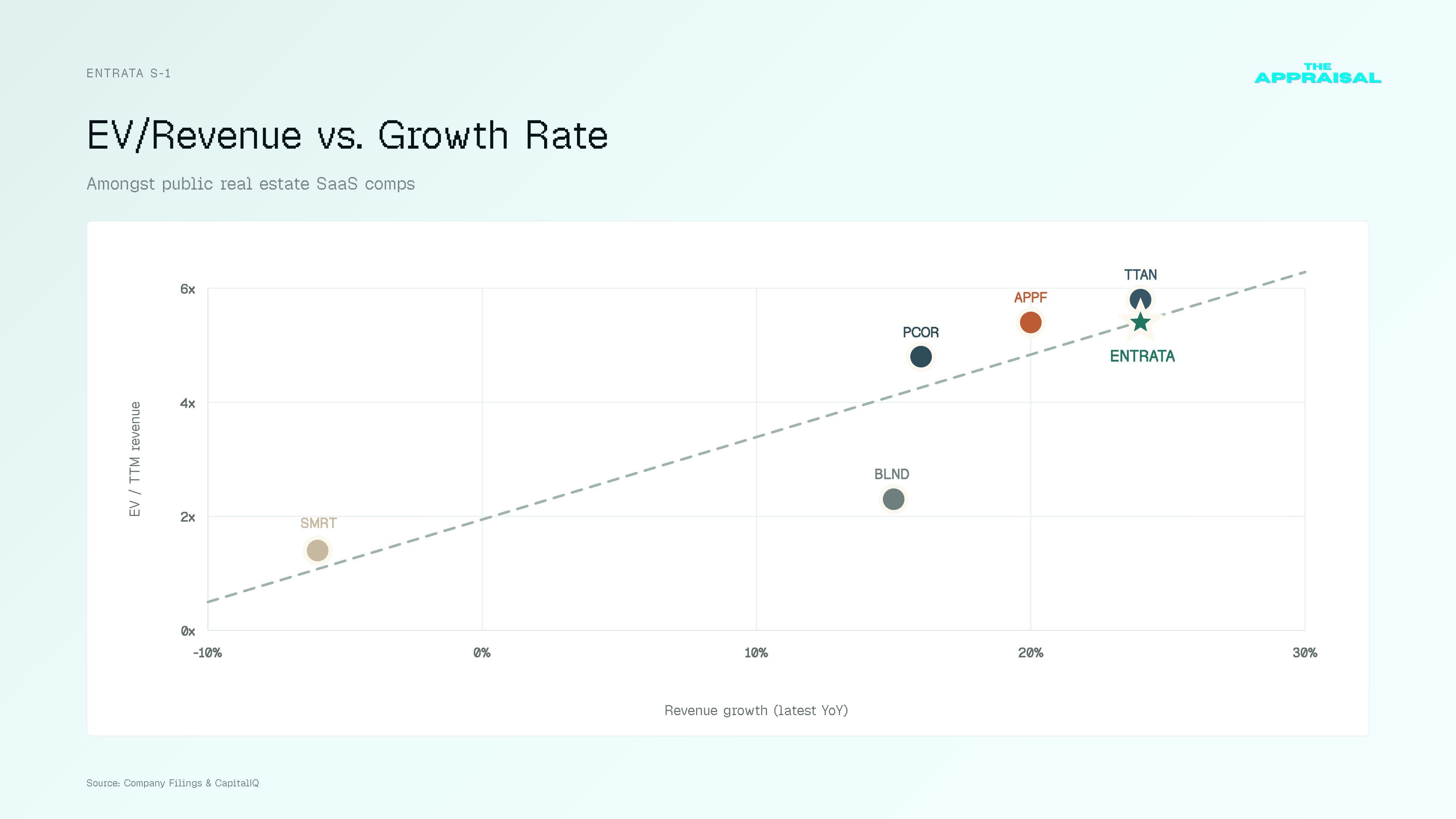
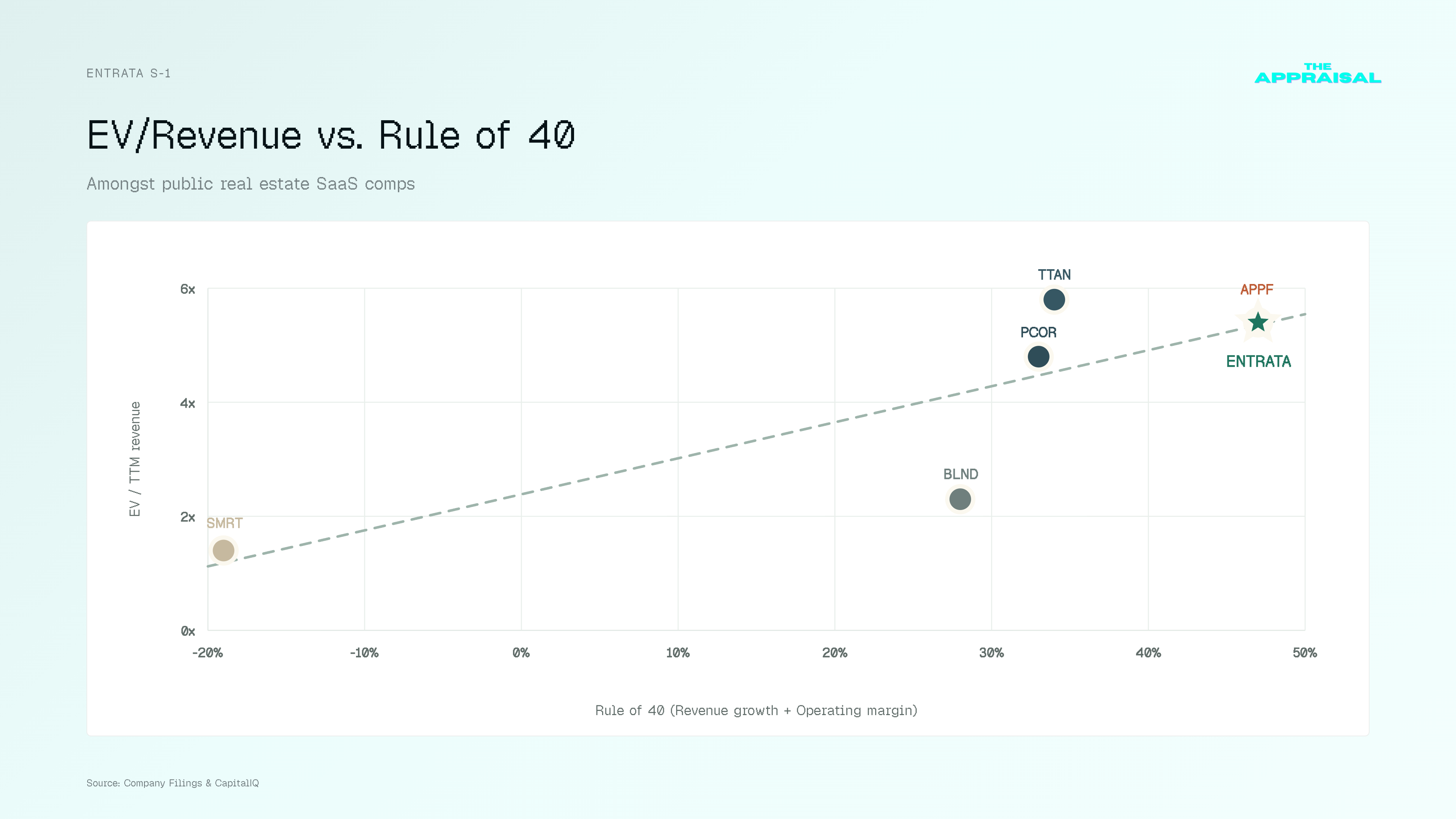
As discussed above, the closest public comp is AppFolio at ~5.4x revenue. Run Entrata through the same lens (similar growth, identical Rule of 40, comparable margins) and the comp set converges on roughly that same ~5.4x. That implies an enterprise value around $2.7B on trailing revenue, closer to $3.3B on a forward basis. For context, Blackstone invested in Entrata at a $4.3B valuation in May 2025.
Bull case → Entrata is a durable, profitable system-of-record that keeps getting more valuable over time — compounding at ~20%+ by layering payments, lending and other ancillary software products. It monetizes its existing install base harder (more revenue per unit) without having to win new logos to maintain growth.
Bear case → Entrata is one of several players competing for share in a crowded, competitive PMS category — up against entrenched incumbents like Yardi and RealPage, public peer AppFolio, and emerging AI upstarts. Its decelerating growth is an early signal of this trend. A wave of AI-native challengers will rebuild the leasing, billing, and operations stack as agent-first products rather than modules bolted onto a two-decade-old platform.
Where do I expect pricing to land? We can look to ServiceTitan’s public market performance as a guide (see my S-1 breakdown here). The company went public in December 2024 as the best vertical-SaaS story in years — popping 42% in its IPO to close at $101, and ran to ~$129 by May 2025, valuing the company at well north of 10x revenue. Since then, ServiceTitan’s share price has been cut roughly in half. It trades at around $64 today, closer to 5–6x revenue — and that’s despite growing ~24% the entire time. The business kept executing, but the multiple compressed anyway, as SaaSpocalypse fears scared off software investors in an AI world.
Thanks for reading! As always, please feel free to share feedback or thoughts on this newsletter — you can find me on LinkedIn and Substack. If you have any colleagues that may find The Appraisal valuable, please share this newsletter.
Note: Charts and graphs provided within are for informational purposes solely and should not be relied upon when making any investment decision. The content speaks only as of the date indicated. Any projections, estimates, forecasts, targets, prospects, and/or opinions expressed in these materials are subject to change without notice and may differ or be contrary to opinions expressed by others.