


I’m excited to release the inaugural State of AI Adoption in Real Estate report. You can download the full report here, and I’ve included my highlights below.
The real estate industry has caught AI fever. Over the past year, the universe of founders building AI tools for real estate has exploded—spanning acquisitions, property management, leasing, underwriting, and everything in between. Last year I published my list of the top 50 companies at the intersection of AI and real estate. That list could easily be twice as long today.
But how much of this is hype, and how much is actually landing with operators? To find out, we partnered with our friends at Keyway to survey 150 real estate professionals across firm sizes and functional roles. The goal was simple: understand the true state of AI adoption—what’s being deployed, what’s being spent, and what’s getting in the way. The findings are now available in our first State of AI Adoption in Real Estate report.
You can download the full report on Keyway’s website, and I’ve included my key takeaways from the survey below.
1. The Pilot Paradox
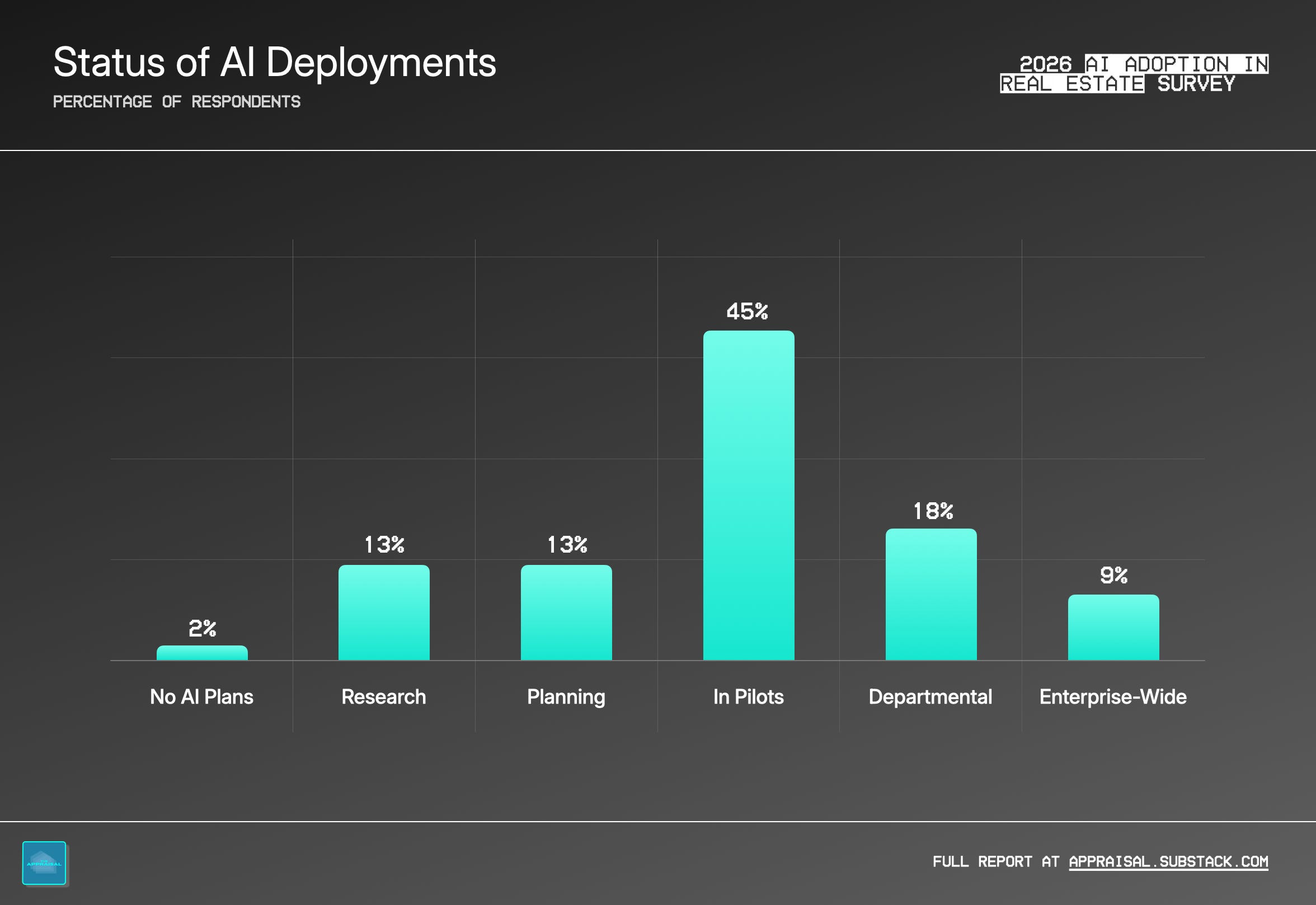
The real estate industry has embraced AI experimentation with remarkable enthusiasm. Forty-five percent of firms are actively running pilot programs, and another 26% are in research or planning phases. Only 2% report no AI initiatives whatsoever.
Yet this activity has not translated into scaled deployment. Just 9% of firms have achieved enterprise-wide AI implementation. Another 18% have reached departmental deployments, leaving the remaining 73% either testing, planning, or stalled.
The implications are significant. Nearly half the industry is investing resources in pilot programs. The pilot-to-production bottleneck appears to stem from multiple factors: inadequate data infrastructure, unclear success metrics, and organizational resistance to moving beyond controlled experiments.
The root cause may be architectural. Investor Jamin Ball argued that assistive AI—tools designed to support rather than act—hits a natural ceiling:
Jamin Ball recently published a good post on why so many pilots stall:
An assistive system still depends on human attention to move forward. And human attention is exactly the scarce resource companies are trying to escape.
This is why so many AI initiatives feel stuck in a strange middle ground. They are clearly useful. They are often loved by users. And yet they fail to produce the kind of economic impact that was promised. The problem is not that the AI is bad. The problem is that it has no authority.
Real estate firms may need to decide: keep AI in an advisory role and accept the “attention tax” or grant it the authority to act and redesign workflows around that shift.
2. The Trust Barrier
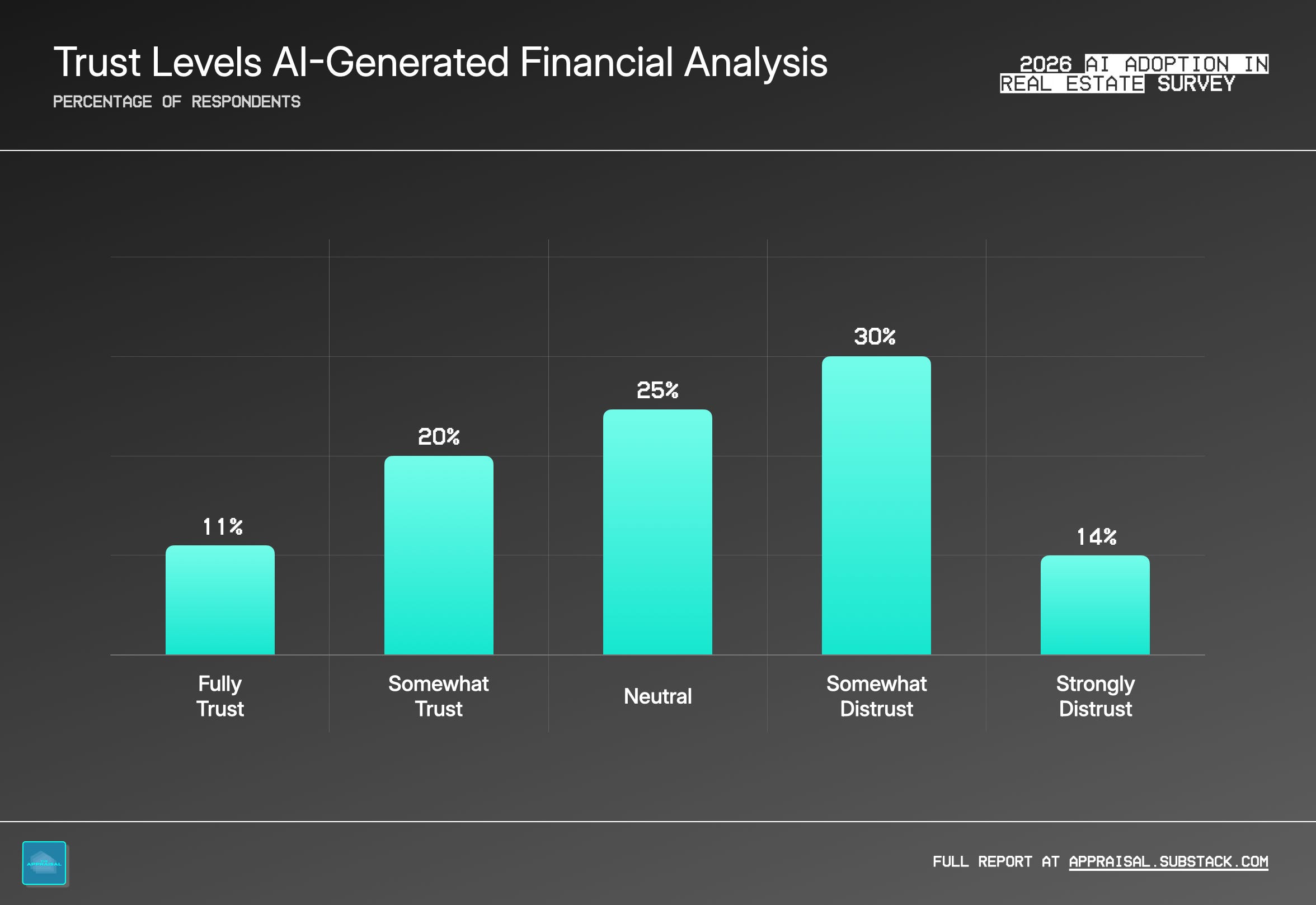
While most real estate operators are optimistic about AI’s potential in the sector, many remain skeptical of the reliability of today’s models. Nearly half of respondents report that their firms distrust AI-generated financial analysis. Only 11% describe fully trusting AI outputs.
This trust deficit creates a ceiling on AI’s potential applications. While firms can deploy AI for back-office efficiency gains, many of the highest-value use cases—underwriting support, market analysis, and deal evaluation—require a level of firm-wide trust that currently doesn’t seem to exist at many organizations.
Harvey co-founder Winston Weinberg recently described how the company cleared early trust hurdles by a) augmenting LLM outputs with detailed sources and b) keeping lawyers firmly in control:
So one of the largest advantages that we had in the beginning was how much emphasis our product had on citations. It was very important in the legal industry to be able to cite, like, line by line and [ensure] the accuracy of those citations.
[Lawyers] are actually in the loop at all times. When you’re selling to an in-house team, it is better to sell them the specialized versions of tasks that they can kind of see an insanely high accuracy level on. And the more specialized you’re building, the higher accuracy you can get because it’s easier to fine tune, it’s easier to do evaluation because there are less steps, and the surface area is just smaller.
Real estate AI products may need to follow a similar path: build narrow, specialized tools like lease abstraction or comp analysis where accuracy can be demonstrably high, and keep professionals in the loop at every step. Trust compounds from there.
3. Bullish on AI, Bearish on Layoffs
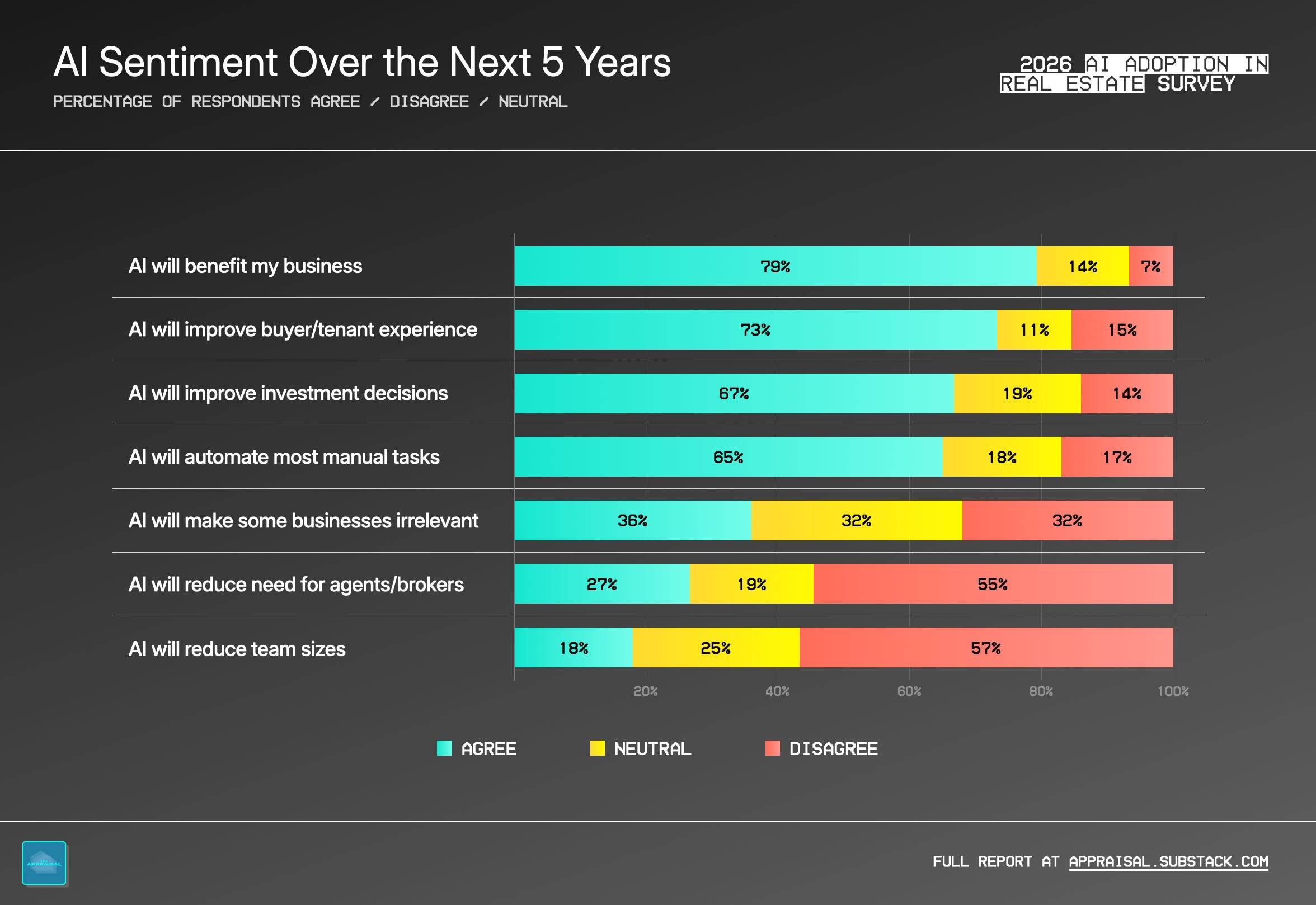
Real estate professionals are genuinely optimistic about AI. Nearly 80% believe it will benefit their business over the next five years.
What’s notable is what respondents don’t expect: job losses. Only 18% believe AI will reduce team sizes, while 57% actively disagree. And behavior tracks with belief—91% of firms are using AI to boost efficiency, but just 18% plan any headcount reductions. Among the firms that have already deployed AI enterprise-wide, not a single one is planning cuts. The prevailing view is that AI makes teams more productive, not smaller. Real estate has landed on an augmentation model, treating AI as a tool that amplifies human judgment rather than a technology that replaces it.
4. AI Spend Is Rising
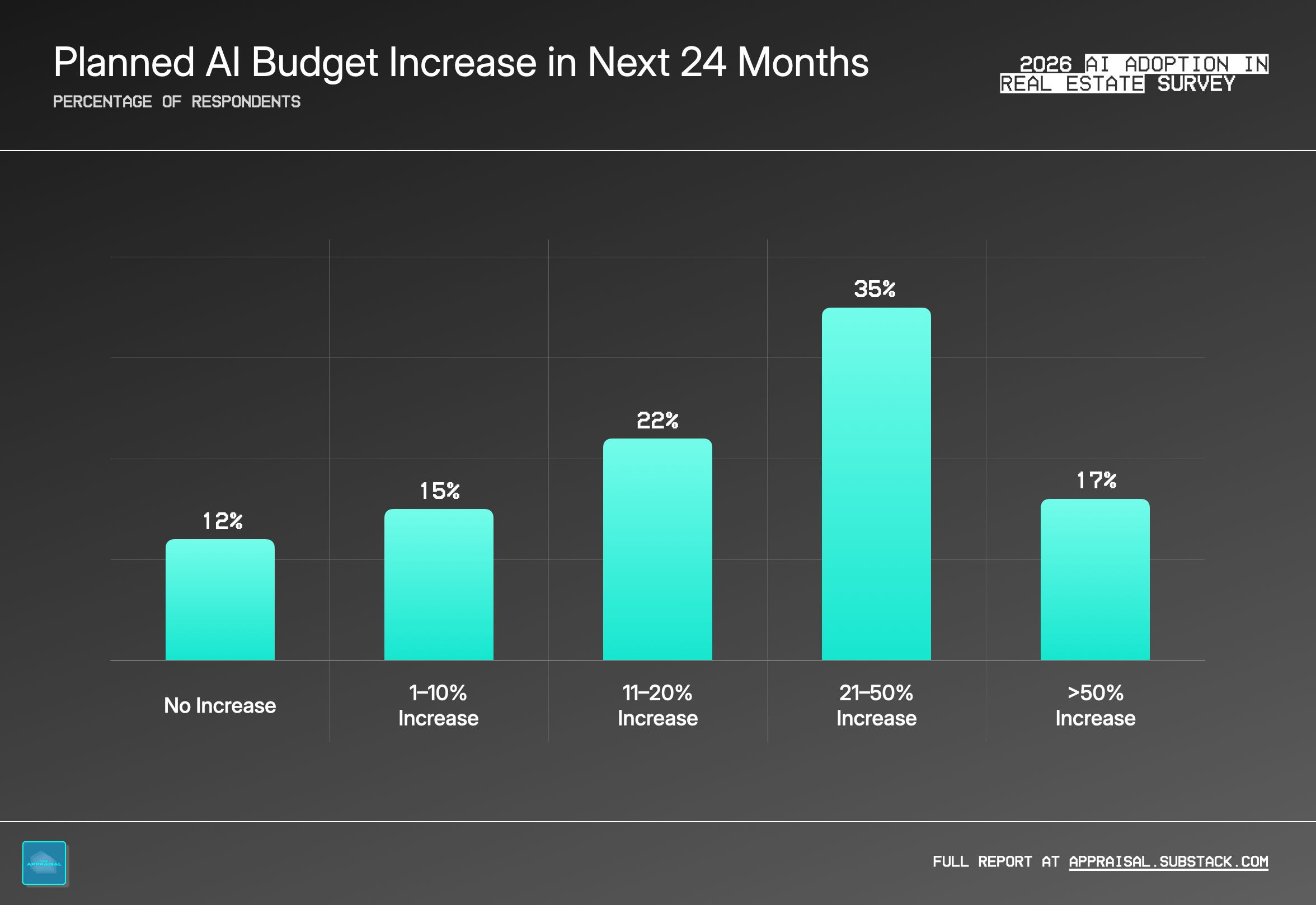
More than half of respondents plan budget increases more than 20% for AI initiatives over the next two years. An additional 22% plan increases in the 11-20% range. Only 12% anticipate flat or declining AI budgets.
These are substantial commitments that will reshape technology spending across the industry. For a mid-size firm with a $2 million technology budget, a 20% AI allocation represents $400,000 in annual investment—funds that must be sourced from existing operations.
To fund these increases, firms are primarily targeting reductions in outsourcing (43%) and administrative costs (41%), rather than relying on headcount reductions (18%). Firms are betting that AI will generate sufficient productivity gains to fund its own expansion without requiring staff reductions.
The full report includes additional data on adoption by firm size, asset class, and role, along with detailed breakdowns of where legacy vendors are winning and where new entrants are gaining ground. Download it HERE.
As always, please feel free to share feedback or thoughts on this newsletter — you can find me on LinkedIn and Substack.
Note: Charts and graphs provided within are for informational purposes solely and should not be relied upon when making any investment decision. The content speaks only as of the date indicated. Any projections, estimates, forecasts, targets, prospects, and/or opinions expressed in these materials are subject to change without notice and may differ or be contrary to opinions expressed by others.